9.04.2013

Canning jar cork holder

Years ago I found a few big canning jars at a yard sale, and they've been perfect for making sun tea. Big enough to make it worth my while, small enough to fit in the refrigerator alongside the milk. And in a tiny junk store in Curlew a few years later, I found a box of aluminum jar rings with dog bone openings, with matching glass seals.

I was packing away my sun tea jars today, and it dawned on me. Canning jar + aluminum ring - glass seal = the perfect display jar for wine corks.

The jar sits on a stool next to the sideboard in my farmhouse kitchen, where we serve wine. Pull the cork, drop it through the opening in the lid, simple.

Finding uses for my collection of old canning jars is always a good thing, and the look is perfect for my country kitchen. Doesn't get better than that.

9.02.2013

Yakima Canyon in flood

This is one of my favorite places, and not just because the twisty road was made for my MX-5. I love the way the road hugs the river, and how the hills change from season to season. Whether covered with snow or with golden grass, they're equally beautiful. If we're lucky, we'll see eagles and hawks soaring on the air currents.

On a road trip through Idaho last May, we drove the canyon on the first day, and on the last. The river was high when we started our road trip, and was in flood when we came back because of back-to-back thunderstorms on the eastern slope of the Cascades (where the Yakima River has its origins).

Come fall, the water will drop and the river can be waded by fly fishermen. I'm looking forward to that. But for this one day in May, I loved seeing the canyon full of a rushing river.

Looking for snakes... and a geocache


There's an eagles nest in one of the pine trees along the river.


It's a short walk from the highway down to the cliffs.


That row of trees is currently on an island... it isn't supposed to be.


Flooded fields near Canyon Road, at the mouth of the canyon.

9.01.2013

Octagon barns

Back in 2007, while on a round-the-state geocaching road trip, we stumbled across the most amazing barn. It was getting on toward dark, and the light was so perfectly beautiful. We never did find the cache that was nearby, and we never forgot this beautiful barn.

Last spring we headed off on another road trip, and I wanted to find the barn again... and find the geocache. This time I had a source of information, the Washington Heritage Barns website. My sister and brother-in-law's barn is on the registry, and chances were good that this octagon barn would also be listed there. I found the barn easily, but was surprised to learn that there are ten barns of this type in Washington, and two in Whitman county.

Our "lost" barn is known as the Steinke Round Barn, located on WA-23, 5 miles west of the town of St. John. The barn was built in 1916 by Max Steinke on land purchased by his father, Theodore Steinke, around 1900.


The other barn in Whitman county is known as the T.A. Leonard barn, and it's on the Old Moscow highway about 1.5 miles SE of Pullman. Located on the eighty year-old family farm in the wheat-producing Palouse region, the Leonard Barn has remained relatively unchanged since it was built in 1917. It's green, which is one of my favorite colors for a barn. And besides being a Washington Heritage Barn, it's been on the National Register of Historic Places since 1986, and photographs of the barn are on the Library of Congress website. If you're curious what an octagon (or round) barn looks like on the inside, you can check it out here.

Last spring we spent quite a bit of time photographing the barn... and we did find the geocache. Next road trip around the state, I'm pretty sure our route will take us to each of the other nine barns.

8.27.2013

Fly fishing diaries | Excuses, excuses

We went to Orvis today to use our $25 certificates from our Fly Fishing 101 class.  We've been holding out for sling packs, have looked at a lot of them, but decided the Orvis Safe Passage Magnum pack fits our needs the best.

We also picked out a few other essentials, like a holder for tippet spools, dry floatant, a pin-on zinger, and a few PMD dries, which are recommended for fishing the Cedar River in the evening hours.

While we were discussing the sling pack and how best to set it up, a man walked in with his cell phone in hand, and it rang. He answered it, listened briefly, then said, "I'm about to go into a meeting. Can I call you back later?" Then he hung up and started looking at fly fishing waders.

I just smiled. Not too long ago, I'd have been tempted to do the same thing.


8.22.2013

My sister's baskets

My sister, Laurie, has always been creative, and so often her talent leaves me speechless. Her latest self-taught craft is the art of basket making, and the collection of small baskets displayed in her house clearly shows her skill.

Laurie first got interested in making baskets 6 or 7 years ago. She collects all the materials, including cedar bark, cattail, tule, sweetgrass (a sedge), and bark such as cherry and maple. She admits to loving the process of gathering materials almost as much as she loves weaving them into baskets.

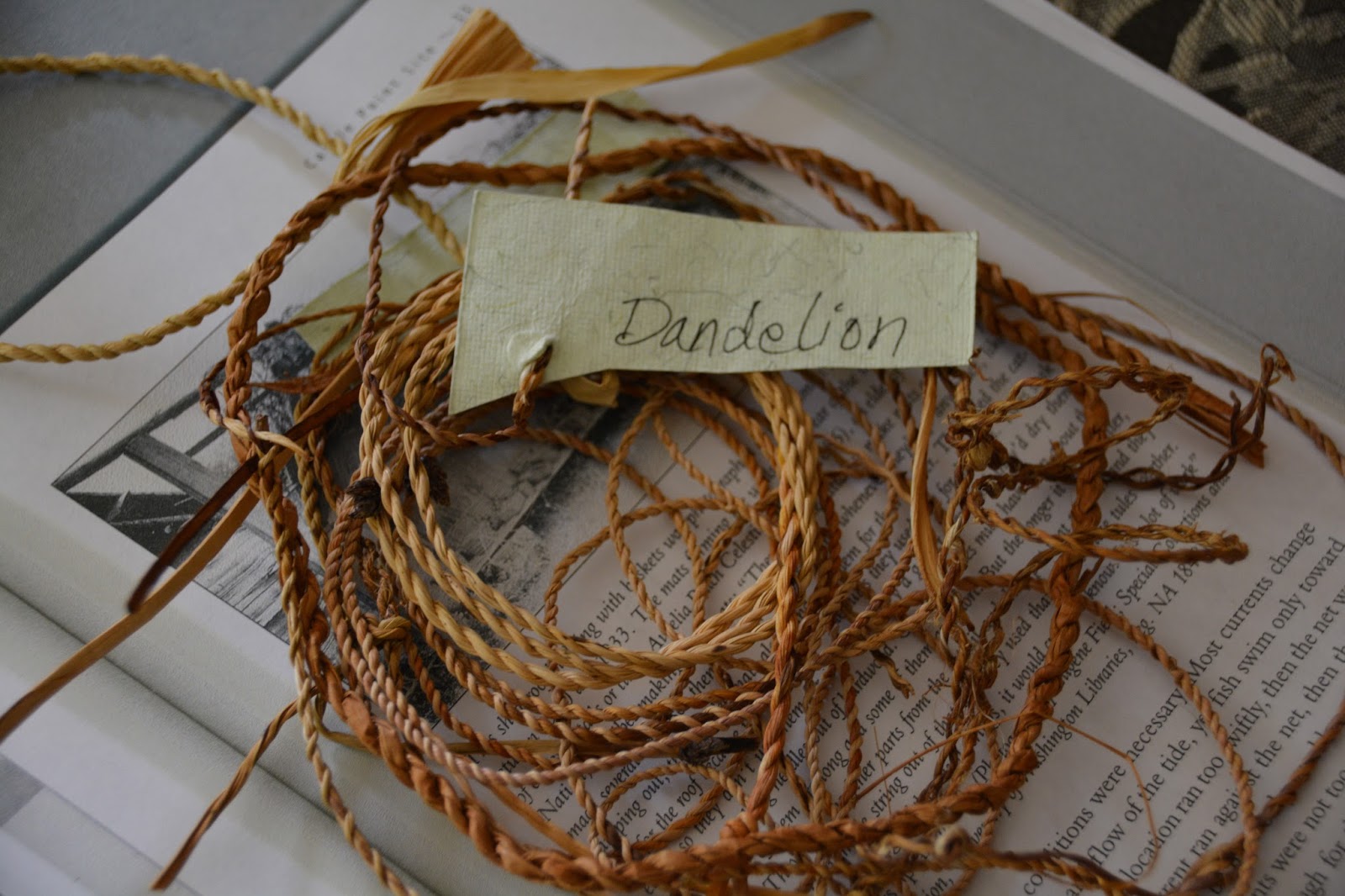
The twine pieces in this photograph are samples of cordage made from various materials:  cattail, sweetgrass, dandelion stems, and nettle fiber. She says making twine is fun and easy, something they demonstrate and teach to their historical museum's visiting school children, even the little 1st graders. This year they taught the 7th graders how to make twine from cattails.

Tiny, delicate bits of twine made from natural materials are ready to weave into a basket.


My sister says it’s not hard to learn the basics of basket making, but it’s much harder than it looks to make a really beautiful, well-crafted basket. She has the knack of seeing how a basket is constructed, the materials used and the patterns needed, but says it's harder to make her fingers do what her brain tells her to do. Basket weaving requires patience, and lots and lots of practice. She gets together with a group of friends every week, and that helps keep her motivated.

Here are some of her creations.


The string of shells that decorates this basket ends with a limpet shell


The small stone bear perfectly matches the colors in this basket,
which is decorated with a feather from a Steller Jay

This tiny basket with two different weaves is only about
three inches high, and less than an inch thick
The basket to the right is woven tightly around a closed clam shell that's
filled with tiny shells and stones to make it a rattle. The basket holds the
shell closed, and it makes a lovely hollow sound when shaken.


This beautiful loosely woven basket is made from seawood, and holds a collection of shells

This basket has a braided handle, and the top edge
is decorated with strings of wooden beads

8.21.2013

North Cascades smokejumper base

All my life I've known about smokejumpers. They're the first line of offense for the brush and forest fires that plague the Northwest during late summer and early fall. But today we found out that you can actually tour the jumper base that's near Twisp. We were on the last day of a road trip through B.C., Montana, Idaho, and Washington, and wrapped the tour into our day. Glad we did.


Did you know that smoke jumping originated here in the North Cascades? We didn't. That was just one bit of fascinating information we learned during our hour tour, which included watching a FAA-certified parachute packer folding and packing the chutes that just came back from a drop, exploring the plane that takes the jumpers to a fire zone, and learning about the gear the jumpers carry, and the extra gear that's dropped with them.

Jumpers go first into a fire zone, hoping to contain a small fire before it blows up out of control. If they can't do this, they often cut out a helicopter landing zone so ground crews can be brought in to fight the fire. If there's no road out, they walk out. 


8.20.2013

Old Molson

We first discovered the ghost town of Molson while on a state-wide road trip in the MX-5, searching for geocaches to complete two caching challenges:  the Washington Counties Challenge, and the DeLorme Map Challenge. Fun times, back in 2007. We've never come across anyone else who'd ever heard of this historic spot.


On this road trip through the state, we were showing the town to my sister and brother-in-law. Molson is close to the Canadian border, in an area of high rangeland in the Washington Okanogan. Beautiful scenery in an area with a harsh winter climate, gorgeous rivers and lakes, great fishing, and for sports car owners, great twisty roads. We love it here.

If you visit between Memorial Day and Labor Day, you'll be able to visit the museum, which fills the entire 3-story brick schoolhouse, and is run by volunteer labor from the community.


If you're curious to learn more, you can read about Molson's history here.

Sherman Pass bones

This small set of bones is not an official part of the viewpoint at the top of Sherman Pass, but someone thought they were worth rescuing and putting on display. Walk down the path from the viewpoint, toward the new gazebo that looks north over the old fire zone. And on the way, you'll spot the bones on a granite boulder.

It's a reminder that there's always something to see along the path, no matter where you are, and no matter what the destination might be.

Vintage Seagrave

One thing I love about exploring the back roads is that you never know what you'll find. The unexpected roads, the secret streams and hidden waterfalls, the flush of new fall colors, the sight of a moose grazing near a river. Whenever we travel by road, my camera rides on my lap, ready for whatever I see.

Today the unexpected was an old Seagrave fire engine, slowing rusting away in a vacant lot in Curlew. Red and rust, with surprisingly bright emblems and badges. There was no indication of year, but if I had to guess, I'd say it was probably made in the late 1940s.

Peter and I were out of the car before it came to a stop, cameras in hand. We walked around and marveled at all the detailing, the bits and pieces you wouldn't expect to find intact, given its age. A quick search told me that Seagrave has been making fire engines continuously since 1881. I hope this fellow is slated for restoration.


8.19.2013

Zero moose

I looked everywhere today, in their last remaining habitat, for signs of my favorite woodland animal. No luck.

Not in the wide valleys and brushy meadows in Waterton park, or in Glacier National Park.

Not along the Pend Oreille River on its course through northeast Washington and into Idaho. Not along the Kettle River from Canada through Curlew and south, even though we saw a lot of the habitat that moose love.

Not even around the beaver ponds in the highlands above the Pend Oreille river, on the drive to Gardner Cave. The ranger there said she's often seen moose at the beaver ponds, especially in the early morning and late evening hours, but we couldn't wait until the perfect time.

After our cave walk we spent some time at the beaver ponds. It's one of the most peaceful places I've ever seen. I sat beside one of the ponds and wished I could have stayed there for a couple of hours. The light was so beautiful in the late afternoon, and the clouds were reflected in the still surface of the pond.

It would have been the perfect place to be, if there had just been a moose.