Showing posts with label Growing things. Show all posts

11.22.2015

Growing on walls...

Ireland was full of sweeping vistas of hillsides and fields. Beautiful shorelines, with the wide blue ocean streatching to the horizon. But the stone that frames the distant views holds another, more intimate look at this magical place.

Violets sprouting from a crack in a wall in Kinsale

A flower garden grows on this stone wall in old town Kinsale

Black stemmed ferns grow on this wall inside Charles Fort, Kinsale

Violets

Lichen on an ancient wall and water wheel, Dingle Whiskey Distillery

Wall around the Seven Churches graveyard, Inishmore

Stone walls frame the historic waterway in Galway City

Violets on crown of old city wall, Derry

Violets, city wall, Derry

Daisies in opening in curtain wall, Dunluce Castle, Bushmills, County Antrim

A garden grew on this wall along the river

Daisies growing on shelf inside Dunluce Castle, Bushmills, County Antrim

Grass growing on top of Newgrange passage tomb 

Creeper on Georgian townhouse, Dublin

In Cong, a cottage and river wall merge into one, covered in creeper

8.07.2015

Berries for breakfast


The heat is getting to the blackberries faster than I can pick them. We walked a trail near home a couple of days ago, and one of the best things about the walk was the 200 foot stretch of blackberry vines to nibble from.

DW mowed most of our blackberries last week, but he always leaves a couple of patches for me to pick from. And some of the best berries come from bushes (I use that term loosely) that grow near the house. It's easy to dish up cereal in the morning, then walk out and pick berries to add to the bowl.

Yum.

The baby buck grazed his way through the flower gardens this morning, and ended up nibbling new blooms and berries from the blackberry vines by the house. I stood watching with my camera in hand, and DW said, "Don't you have enough pictures of deer?" Maybe. Maybe not.

8.03.2015

Orchard in the heat


The orchard is suffering in this heat. The fruit is coming on fine, but the leaves are a bit crispy. I hope it rains soon. We need it.

The red Delicious apples look beautiful, already starting to turn red.


The baby buck was grazing under the trees this morning.

8.06.2014

August in bloom...

My garden is peaceful and dormant in August... most of the perennials have bloomed, but the lace cap hydrangea and second bloom of the Centaura montana, the hanging basket of geraniums, the hostas, the garden phlox, the smoke tree, the daylilies... they're all beautiful.


It's a month to catch up with the weeding, and not worry about tending the blooms. It's time to think about picking blackberries at the farm, and start making pie dough. To watch the huckleberries swell at the lake property, and anticipate the first signs of chanterelle mushrooms poking their heads above the moss.

And while we're thankful the summer heat means the lawn has gone dormant, the biggest job of the summer is still ahead of us:  mowing the pastures and clearing out the fencelines.

A goat (or six) would be helpful right about now...

7.19.2014

Baby violets, part 3

I've been propagating African violets in water, and I'm totally sold on this approach.

The first batch of African violet leaves sprouted roots so quickly, I decided to try it again. With the extra light of summer, these had roots in about a week, and baby leaves in just ten days.

Of those first plants, the ones that did the best were left in water until the tiny leaves grew larger, then I planted them. With each, I left the "parent" leaf intact. I'm not sure this had any benefit, but it sure didn't hurt. After all, it was this leaf that sprouted roots, so just as much a part of the new plant as the tiny new crown of leaves is.


Since the first experiment worked so well, I'll do the same with these new leaves. It will give me time to find more of these small McCoy pottery planters!

This is so easy, it just may become a new hobby.

You can read about propagating violet leaves in water here and here.

6.27.2014

Friday finds | Little acorn

When I gathered blooms to bring indoors today, I spotted this small acorn tucked underneath the Lady's Mantle. It still has its frilly collar, but the nut is just a web of fibers. It's damaged and no longer whole, but beautiful just the same.


4.26.2014

Blue skies and dirt...

In the spring, at the end of the day, you should smell like dirt.  Margaret Atwood


It was one of those picture-perfect spring days,
and all I wanted to do was get outside and be part of it.
Kneel in the dirt, and get my hands dirty.
Fill up the wheelbarrow with weeds.
Prune back the ferns and peonies.
Make room for this year's growth.

The big perennial border doesn't quite know
what to do now that the huge fir tree is gone,
and the ground is flooded with light.

Shade-loving plants like ferns and Hellebores
have doubled in size, seemingly happy with more light.
The forget-me-nots that last year provided a thick
carpet of blue, have all but disappeared.

My winter-hardy rosemary made it through winter
then promptly died as soon as the warm days arrived.

Sigh...


Just two years ago, I would have stressed about
finishing this flowerbed in a single weekend,
working through aches and pains in the single-minded
need to get it done. No longer. I take things in small
chunks, with more care, and with stops to take photographs
and imagine what plants would go best in the empty places.

So I stopped after three hours of weeding and digging
and pruning. And the next warm day, I'll finish it up.

4.01.2014

New roots....

The crown of one of my baby African violets broke off in my hands a couple of weeks ago, and I was horrified. I waited and waited for this baby to grow from a leaf cutting, then carefully tended it. And I broke it.

So to Google I went, looking for the best way to salvage the crown. One gardening website said you could put the crown in water and it would grow roots. Just make a paper collar to support the plant, and make sure to keep the water topped off. This method would also work on leaf cuttings. There's no need to go through the usual process of dipping the leaf stem in rootone, planting it in vermiculite and potting soil, then putting a bag over pot and plant to keep it moist.

I'm willing to try most things once, so I pulled out a beer tasting glass and a couple of shot glasses, cut paper collars, cut an "X" slit in each, and slipped the crown through one and two leaf cuttings through the others, and set the glasses in the kitchen window.


The best thing about this method is that everything is visible. You can see the stem and know immediately when it starts to sprout roots. Just keep the water level near the rim of the glass, and let them be. You don't have to worry whether the leaf is staying moist, or wonder what's going on under the soil. The crown sprouted roots from the original crown. I expected the leaves to form roots just where the leaf and stem joined, but the roots sprouted right where I cut the stem.

Within a couple of weeks the crown was sprouting roots, and within a month, the leaves also had roots. Soon I'll transplant the leaves and crown into pots.

Plus they look really pretty on my windowsill.

3.12.2014

Hello spring...

I'm behind again. So to catch you up all in one fell swoop, here's what I've been doing the past ten days or so.

Reading that armload of books on watercolor painting, before they're due at the library.
Decluttering my life, one closet at a time. There's something so very satisfying about this.
Working on the 2004 WA Shop Hop quilt. Forty four blocks done, twelve to go.
Stitching hexagon blocks for a future Grandmother's Flower Garden quilt.
Washing and ironing my favorite clothes, from babyhood to the 1990s, before they go into storage.
Rooting leaf cuttings from my African violets, in a row of shot glasses in the kitchen windows. Planning my gardening chores, now that spring weather is finally here.
Thinking about fly fishing adventures for summer and fall.

Two days of warm sunny weather in a row is cause for celebration, after all the rainy days and cold mornings. The forsythia is in bloom, and so is my winter rhododendron. The perennials are all above the soil, and it's time to run the winged weeder around the beds, then spread wood chips. There are branches to collect and toss on the burn pile, and we have a couple of stretches of old fencing to pull out with the tractor.

Tomorrow it begins...


11.20.2013

Orchard pruning

We waited a long time for fall to arrive, for the trees to go dormant. Impatiently, as we'd decided it was time to do some major pruning in the young orchard, and were anxious to start. This orchard always been the misfit, with trees planted too close together by a previous owner, then badly pruned so the trees never had the structure they needed to grow up straight and strong.

And we added neglect to their lineage... waiting too long between pruning sessions, and allowing some suckers to grow too tall and too big.

Today we fired up the chain saw and hauled out the ladders, cut branches and suckers, stood back to contemplate how deeply to cut, what to leave, what to remove, then moving on to the next tree. There was damage to repair, too...  trees that bore the brunt of the ice storm in 2012.

While he cut, I hauled branches out to the yard. On another day soon, we'll cut the branches into firewood, and stack the small stuff to burn next spring. We've pruned so much this fall:  our burn pile has grown to three piles, and will soon be five. And we still have hand pruning to do, to thin out the branches for better air flow and light.

The mess is huge, but it's beginning to look more like a healthy orchard. That makes it worth the aches and pains. That and the good feeling that comes from a day of hard work, done together.


4.19.2013

Celebrate the rain

Today it's pouring down rain, the gutters are overflowing, and I'm feeling stranded. I'd rather be outside, digging in the dirt. Or on a walkabout with my new Nikon, trying out the settings and features I've been learning through online videos. But I'd be soaked in minutes (and so would my camera).

So instead, I'm celebrating the rain, and the good things that will come of it. The pond is overflowing, which gives more room for the ducks who are settling down to raise their families. And the frogs are ecstatic (if such a thing is possible for a frog). Lots of water, oodles of rivulets running down the private road, lots of drowned grasses and weeds to explore.

Weeds are exploding in the gardens, too... thanks to this over-abundance of water. I swear you can almost see them growing from day to day, and that's actually not a bad thing. I'd much rather wait and pull big weeds, than try and pick out tiny shoots.

The perennials are already larger than this time last year, especially the hollyhocks and garden phlox. The forget-me-nots are in full bloom, and the daffodils are still blooming. The blue and yellow are beautiful together. My oldest (and favorite) perennial border is thriving, thanks to the rain (and all the extra light the plants are getting this year). Yes, the weeds are growing. But so are the flowers and ornamental grasses, the ferns and shrubs, the plants I chose and tended and loved for years. I can see this border from the house, and it's going to be spectacular this year. I can hardly wait.


Tulips at the Pike Place Market


Linked at Texture Tuesday
Layers of Marabella (overlay @ 41%) and 1412 (multiply @ 86%)


The original photograph was taken at Seattle's Pike Place Market, where the flower stalls are spectacular, especially in April when masses of tulips are stacked in buckets at the market, waiting to be sold. I love these bright red tulips with yellow edges, with a few mauve blooms peeking out from behind. The photograph had a soft, painterly feel to it, which the textures accentuated.

Tulips at the Pike Place Market (original)

4.03.2013

Long-ago rose

Today was a perfect spring day, and it's time to buckle down and weed the flower beds. Don't get me wrong, it's actually something I enjoy doing. Digging my hands in the warm ground, searching out every piece of weed and root, smoothing the soil, and spreading mulch. Weeding is automatic, which frees my mind to think about other things, like making vacation plans. When I worked for a living, I'd think about an upcoming project. A lot of my technical writing projects were scripted in my garden: figuring out what documents and manuals were needed, laying out the content, and deciding what languages to translate into.

These days my thoughts run to completely different things, like where I'll walk tomorrow, or what tote bag to make next, or how to texturize a photograph. (And truth be told, what to cook for dinner, and whether to change sheets today or tomorrow. Earth shaking decisions, to be sure.) It doesn't matter... whatever the project, it benefits from a little "garden thinking."

The border of hollyhocks got weeded today, all the way to the peony that anchors the corner. My black hollyhock is already 6 inches above ground; maybe this year (its third at the farm), it will actually bloom. I'm looking forward to seeing the color in person, not just on the plant stake.

Just as I reached the peony, my fingers found this tag from a long-ago Jackson Perkins rose, a Floribunda called Eureka. I remember the rose, and remember picking it out at the nursery a decade ago. Eureka was the AARS award winner in 2003, and I loved the color. But I don't remember planting it in this spot. I'm pretty sure it was at the other end of the border, 20 feet away. It amuses me to think of how the tag traveled all this way. Maybe a vole helped it along, pushing it through his tunnel. Or maybe I helped it along, moving it as part of a shovelful of dirt. I'll never know.


Tomorrow, I'll weed the other side of this "L" shaped border, from the forget-me-nots to the lilacs. It's my biggest border, with the most plants. This one will take a few days.

8.11.2012

Baby violets

Last September, I spent the weekend with my friends, Bernie & Linda, who live in Ellensburg. Linda is famous for her African violets, which thrive in the north-facing  windows of their living room, in the sunny window in the kitchen, actually (and contrarily) in just about any room in their house.


Violets are probably my favorite house plant. I fall in love with the endless variety of color and shape at the nursery, bring home a new favorite, tend it and admire it...  then the blooms fade, and the plant never blooms again.

My current violets are very happy in the south & west light they get in our dining room. They set new leaves, old leaves die, and one of them (I think it has gorgeous magenta flowers with a white edge, but it's been so long I'm not really sure) has actually sprouted a new little violet plant. But as happy as my two violet plants are, they don't bloom.

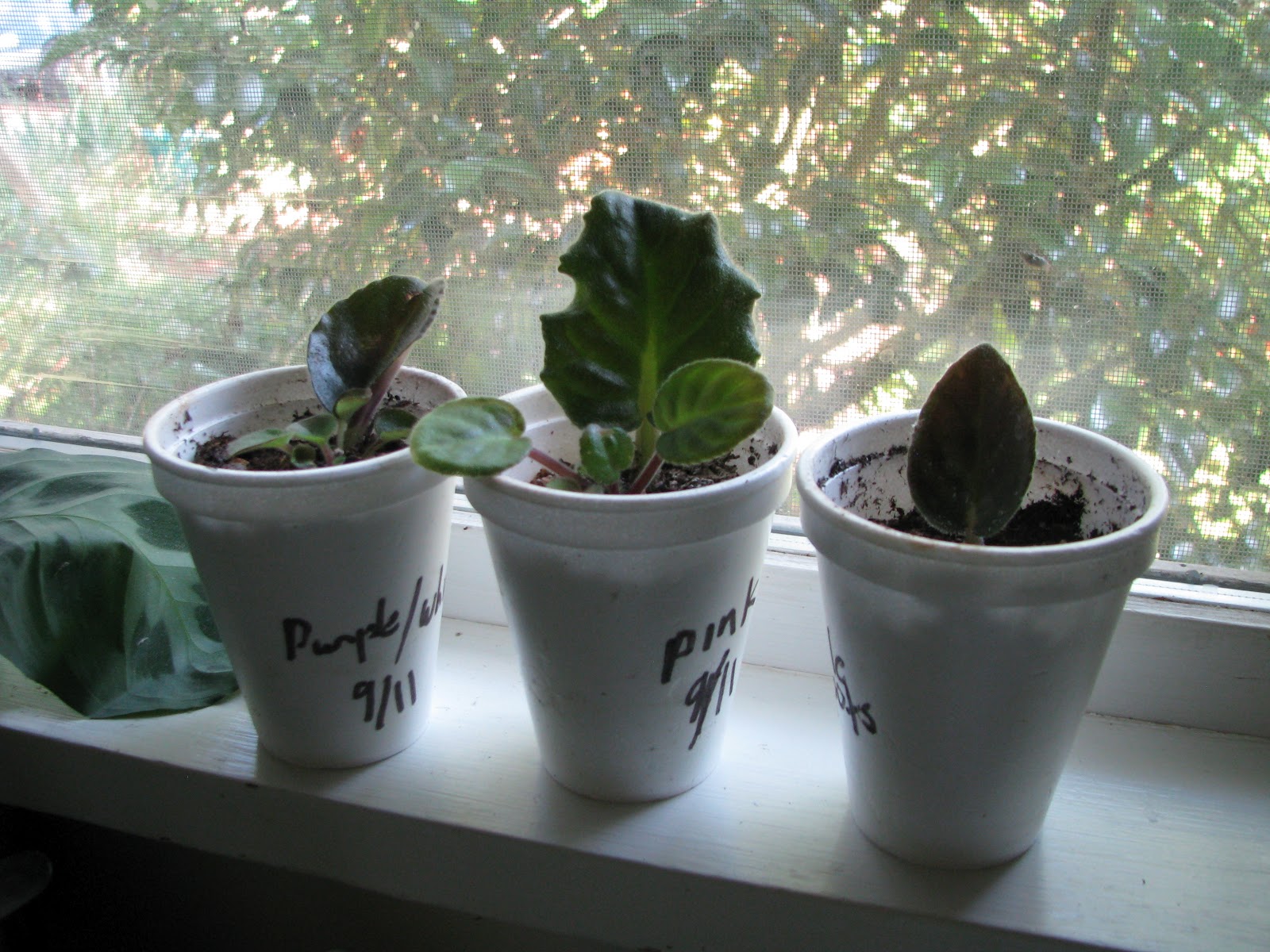
So Linda gave me a crash course in violet care and propogation, and sent me home with three leaf cuttings: each one in potting soil in a separate styro cup, with a "greenhouse" baggie over the top so they'll stay moist.

The violets rode home in the cup holders in my Pilot (bet Honda never thought of this use for a cupholder!). Once home, they moved in with my two violet plants, and there they stayed for 9 months while I watched for baby leaves.

In late June, tiny fuzzy leaves started to push their way through the soil in two of the styrofoam cups, and in just a few weeks, each plant had eight new leaves. The third leaf never sprouted baby leaves, but a tug on the leaf showed it was rooted.

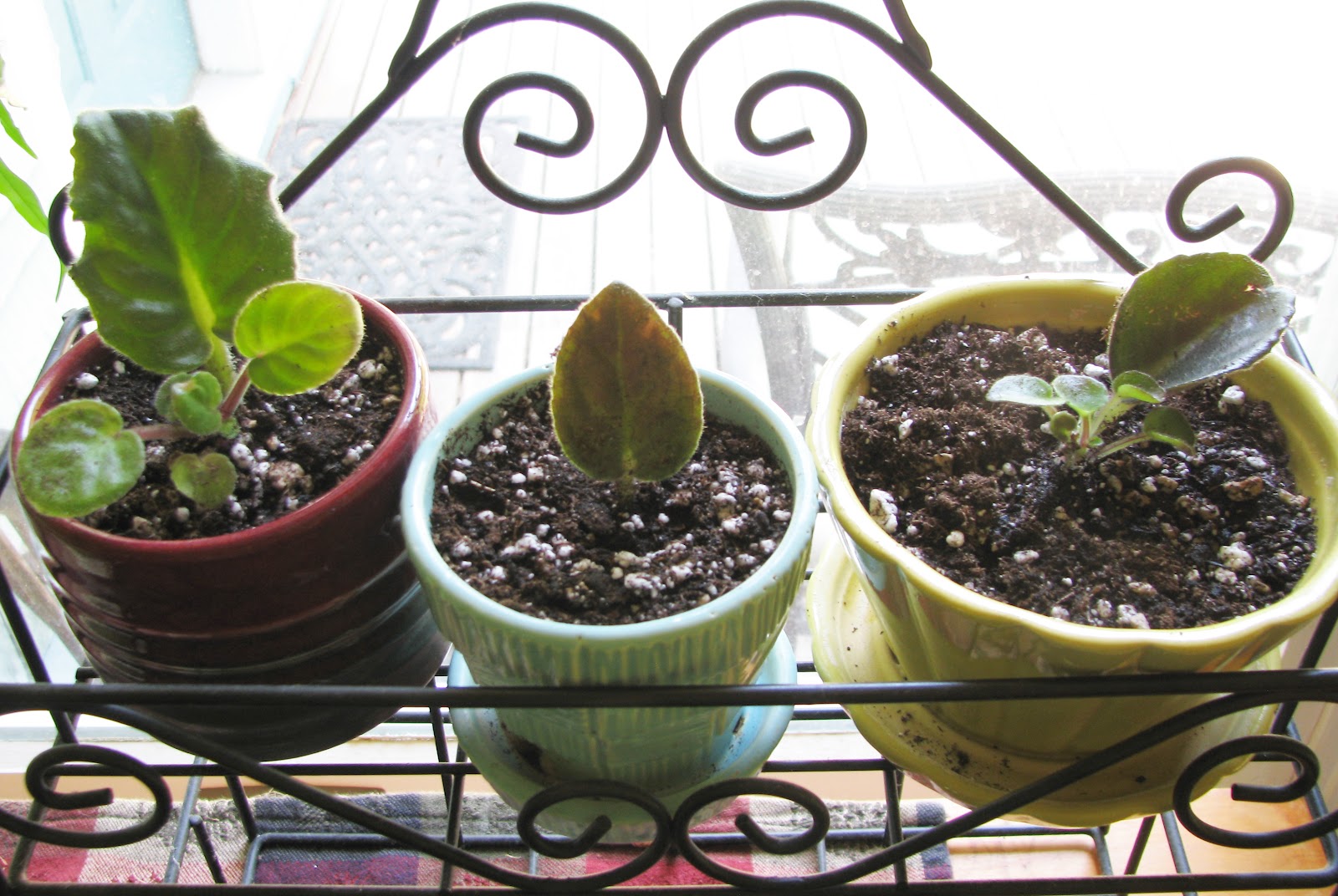
Today I potted the new violet plants into the antique pottery flower pots I've been saving, and my little violet garden has now grown from two plants to five plants.


l to r:  Pink, Pink with purple spots, Purple with white edge

I hope they like their home as much as the grown-up plants do. And I hope they'll bloom.

8.01.2012

July in the garden

A couple of weeks ago I dug out an overgrown border next to the patio, and put in a few new perennials: Lady's Mantle, Shasta daisies, Veronica spicata, and pale blue Delphiniums. The new plants are getting established; the cool weather seems to be doing them good.

I also started some cosmos seeds, taking a chance that an old seed packet would still have a few viable seeds. The gamble paid off, and the starts are looking great. As soon as they're big enough, I'll transplant them into a pair of big pots to go on either side of the porch steps, and we'll enjoy the blooms well into October. Then I'll harvest the seeds for next year. It's all part of my plan to cultivate plants to fill up a new border along the south side of the farmhouse, without having to spend big $$$ at the nursery next spring.


The garden phlox were new additions to the orchard garden last year, and I was surprised at how huge they grew this summer. I put in four plants up against my pole fence, and they each bloomed, and this year the foliage grew more than four feet tall before setting flower heads.

There are two varieties in this border, and both have big, beautiful lilac-blue flowers. One variety has beautiful bronze-green foliage in the spring, which turn to bright green in the summer.

In the border on the other side of the lawn is a volunteer phlox that is busy putting out new plant shoots. It hasn't bloomed, and may not this year. I suspect it's from a white phlox I put in a couple of years ago on the other side of the orchard; hopefully it will do better in the new location. And hopefully it will bloom this year, at least so I know what color it is!

Coneflowers are one of my favorite perennials, and they've graced our garden ever since we bought the farm in 1984. I have three varieties: a white called 'Big Sky Sunrise,' the familiar pinkish lavender, and this deeper red variety, called 'Ruby Star.' It's the first of the three varieties to bloom each year; I'm still waiting for the others to bloom.

Over the years I've learned that these plants do much better in containers on the patio, rather than directly in the ground. But when the new border goes in next spring, I'll try transplanting new seedlings there, and see how they do.

I love the gardens in mid-summer. Blue and purple flowers are my absolute favorites, and this is the perfect time of year for them: the phlox, hydrangea (both mop head and lace cap), Veronica spicata, Campanula, and Scabiosa are in full bloom. The lupine and perennial bachelor buttons are setting up for a second bloom, and the powder blue Delphinium should also bloom again.

My patio hydrangea, the mop-head type, has been in a huge pot since I brought it home from the nursery back in 1998. The small bush looked pretty lost in its large container the first year, but soon grew into its new home. If I prune it gently every couple of years, it thrives on the patio. The first few years, the blooms were pale pink. This year, they're are a perfect periwinkle blue.

7.14.2012

The last garden

The farmhouse at Pennylane Farm sits in the middle of 5 acres, with orchards and paddocks on two sides, a pasture on the third, and a concrete patio and garage on the fourth.

Over the years, the paddocks gradually evolved from enclosures for animals to open areas of lawn. Fences came down, the grass got added to Dave's lawn-mowing area, and the borders were carved out one at a time, becoming home to things like hostas, hellebores, and climbing vines like wisteria. The filtered shade still allows for my favorite blue and purple bloomers, things like peach-leaved bellflower, bachelor's buttons, pincushion flowers, and phlox. The daylilies took longer to get established, but seem happy there now. The last bit of earth in this garden, and the bit that gets the most sun each day, is now planted with hollyhocks. The patio has turned into a beautiful jungle, with big rhodies and hostas and heather and lavender around the edges, and pots of perennials and annuals and shrubs that separate a table and chairs from a firepit seating area.

I've filled up the space I have, and that's been fine until now. While I was working, I had my hands full with the yard and gardens just the way they were. Some years, I didn't even add summer annuals to the perennials in the patio containers, and was more than content. The gardens were in balance with my life.

But now that I've retired, that's all changed. More time means more gardening possibilities. So, where should I garden next?

It's a bit ironic that of all the places I could grow flowers, the only place that gets full sun is the one place I have no flowers at all. And that's because planting a garden there first required digging up the lawn. That was more heavy lifting than I was ready for. So I enjoyed the grass and views of the orchard, and focused on other parts of the yard.

But now that I've retired and have all the time I need for gardening, suddenly I see all the possibilities of that unplanted lawn. Now when I look at the bare side of the house with no trees or shrubs, no trellis or arbor, no spring and summer color besides green grass, I hear it calling me. And I'm listening.

So over the next few weeks, I'll be making lists of the plants and shrubs I've always wanted to have, but can't grow in my current gardens, things that will thrive on the sunny side of the house. I've collected mulching materials, and this fall Dave and I will design out the border and cover the grass with thick layers of cardboard and burlap bags, then cover it with bark. I've already started to gather perennial seedlings, and will plant what I can in the current flowerbeds this fall, the rest in pots. The plants will grow sturdy root systems over the winter, ready to be moved into the new garden next spring. And I've taken a good hard look at the perennials in my other gardens, and tagged those that would grow much better in a sunny location.

I'll post my list as it evolves, and photographs of the garden as it comes together. I'm excited, and would love any suggestions you might have as I plan this garden.

2.11.2012

False spring & forsythia

Last weekend we had four days of beautiful, sunny, warm weather. Just enough to get the gardening juices going, and make me anxious for signs of spring in the garden... the daffodils pushing through the mulch. For purple primroses, and the huge hellebores to start blooming. The fruit trees to start budding out. And I even look forward to the grass starting to grow again (shhh... don't tell my husband).

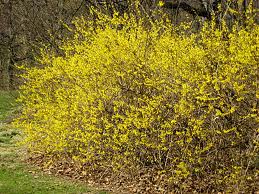
Usually by now I've cut an armload of forsythia branches to bring inside, where I fill my biggest vases and place them throughout the house. I've done this every year since we bought this old farm, and I love the sight of bright yellow blooms opening up, bringing a touch of spring and sunshine in the middle of winter. This year it's late, probably because of our very cold weather in mid January. A few more days should do it, once the buds get just a bit bigger.

My big, overgrown forsythia has never failed to provide a beautiful display of blooms, in spite of a few years of neglect (and some not-so-friendly competition from a 50-year-old wild rose). Forsythia seems to thrive when left to grow naturally, with minimal pruning to keep in in check so it doesn't crowd its neighbors. It isn't happy if brambles (or wild rose) block too much of its sun. It will sulk for a season if that happens, but will bounce right back the next year. I love that it comes to life so early each year, and love the bright green leaves that contrast so well with the rhododendrons that grow nearby. It's the perfect shrub if you have the room, and I think I've found the perfect place to plant another one.

6.24.2011

Easy weed control

A satisfying weekend, digging in the dirt (once it warmed up). On Friday, I finished my new corner sitting area: hauled away the branches, leveled the dirt and raked it into the low corner, dumped ant bait on the burgeoning ant hill… grrr.

To control weeds, I used a technique that also works great for establishing new flower beds on top of a patch of lawn: cover the area with layers of cardboard, stake them in place (or hold down with rocks), and top with a thick layer of bark. I've been bringing home boxes from work the past couple of months; nice to have a free source of materials. I used the U-shape pins sold with landscape fabric to hold them in place so they won’t slide around, then sprayed the cardboard with water. This helps them start to break down. It took the 8 bags of bark I bought this week, plus a 9th, to cover the cardboard.

The corner is now finished, and I love the way it looks. I’ll look for a small side table to go between the Adirondack chairs, something big enough to hold a lamp and glasses. I can see myself sitting out here in the evening, reading and sipping a glass of wine, relaxing after a day at work. And it will be a perfect spot for an intimate talk with a friend, a place to escape a noisy party on the patio.


The other task for Friday was digging the lemon balm out of the last 1/3 of the flowerbed, and planted hollyhocks in about half the bed. Besides the salmon pink double that Marion gave me, I also have a dark red/black single, plus rose red and white (both double). Enough to fill the whole bed, and by next year, it should be a solid hedge of hollyhocks.
On Saturday, I finished my other major chore in the yard today: scraping up the former bark pile that became a small garden, right on top of the concrete parking pad! Between the lemon balm, pasture daisies, and a few other perennials. I had quite the little volunteer garden growing there, but it was time to reclaim my parking spot!

I spread half the rich, loamy soil in the flower border, then planted the rest of the hollyhocks, fertilized them, and spread bark, then hosed the dirt off the driveway. I decided to leave one small lemon balm plant at the end of the border, but will chop the roots occasionally to keep it under control. It’s fragrant, and makes a great filler for flower arrangements.

5.01.2011

Speed planting

Twenty-one containers all cleared out and topped off with fresh potting soil, all I need is plants. I went in search of all my favorites this morning: lobelia, geraniums, sweet alyssum, petunias, verbena, nicotiana, sweet William, yellow and pink and red lilies, million bells for hanging baskets, plus new lavendar and rosemary to replace some that died over the winter. And another hollyhock for the new border, still in the planning stage.

Two hours and 134 plants later, all my containers are full and fertilized and watered. Only 65 plants to go... I may have gotten just a little carried away, but the gardens and patio are going to look great this year!

4.23.2011

Weed Wars

Today was an amazingly beautiful day in my little piece of Washington heaven. The sun was bright, the skies were blue, and it was 60 degrees by 11:30 am. The perfect day to spend in the yard.

The past few weeks I've been clearing out weeds and pruning and spreading bark a few hours at a time, but today was the first full day we both spent outdoors, cleaning up after winter. Dave mowed our acre+ lawn (with only one hiccup: a broken belt on the riding mower that required a trip to the parts store). While he made repairs, I walked through the orchard & pasture areas that we've incorporated into our lawn, and pruned the low-hanging branches of four massive cedar and fir trees. Their branches had grown to nearly touch the ground, which makes it a challenge to mow.

My own gardening task for the day was to finish a new outdoor sitting area in a former garden near the house. A winter storm brought a huge branch down onto the fence that suppported a 35-year-old wisteria, destroying the fence & posts, and damaging the plant. A couple of weeks ago I removed the fence and cut back the wisteria, and gave it a quirky replacement: a two-rail horse jump, using standards I built myself, and rails from our lake property that I scaled and sanded. I love the look. It reminds me of my years as a horse owner and rider, and the reason we bought this property.

Today I needed to find some large rocks for a rockery, and while pruning the cedar trees, spotted a few granite rocks under one of the trees. As I pulled up the first two, I realized that there was a big pile of them, buried under years of needles and soil buildup. Cool! I loaded up the wheelbarrow and hauled them back to the garden, built the small rockery, then backfilled and leveled the ground. It's ready for mulch.

Tomorrow, if the weather holds, I'll tackle a lemon balm hedge that's run amok and crowded out some prize plants: poppies, garden phlox, and peony. These will get a new home in the new border by the sitting area.

2.15.2010

I need a goat

The weather's been so nice the past couple of weeks--spring in the middle of winter is kind of nice (especially when I look back on last winter!). So yesterday, in spite of housecleaning and laundry that desperately needed to be done, I changed to jeans and a sweatshirt, grabbed my leather gloves and pruners, and tackled the brambles.

The John Deere is "down" at present, but the blackberries wait for no man (or tractor). They're already sprouting, and if I don't get after them now, they'll take over. I can't do anything about the huge patches in the pastures, but I can at least clean up the fencelines.

Yesterday I spent a couple of hours pruning, and made pretty good progress. Today I could hardly wait to get home from work and get back out there. I'm halfway to the chicken coop now; should make it there tomorrow.

The soles of my Merrels are full of thorns that catch on the carpet... once I finish the pruning, I can see spending a few hours with needlenose pliers to clean them out!